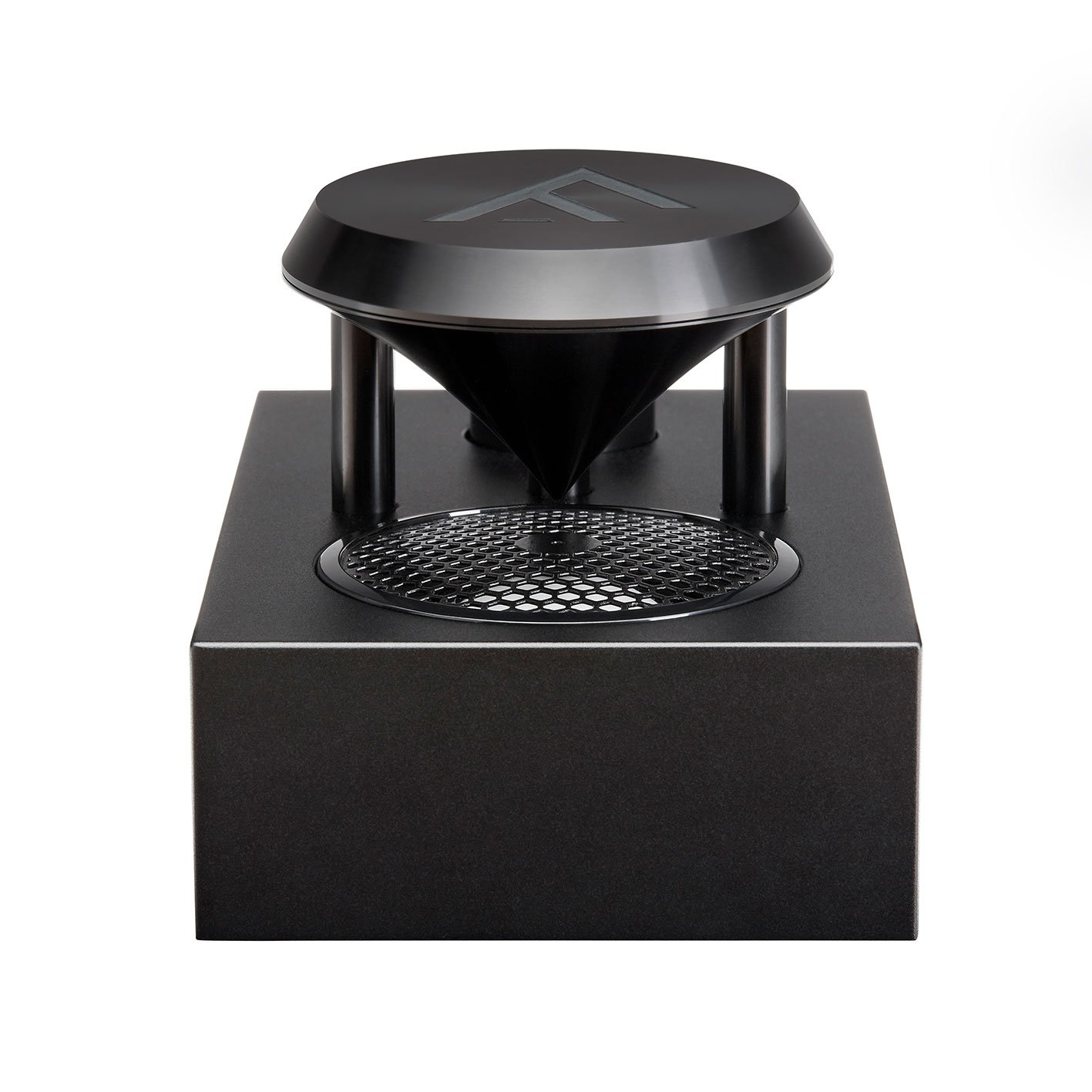
Audio Technique did an in-depth review of the Fyne Audio Vintage Classic VIII SM loudspeakers and the optional S-Trax super tweeter. The article examines how Fyne Audio balances modern acoustic engineering with long-term musical enjoyment, favouring coherence, natural tone, and real-world usability over purely technical specifications. With a classic British aesthetic paired to advanced technologies such as IsoFlare™ and BassTrax™, the Vintage Classic VIII SM is presented as a loudspeaker designed to integrate naturally into the home while delivering a refined, engaging and highly listenable performance.
Translation
Fyne Audio Vintage Classic VIII SM
Classic Looks, Modern Soul
By Keith
Some audio enthusiasts, when researching speakers, often start with dimensions, frequency response, sensitivity, or technical specifications as their point of understanding, as if all aspects of sonic performance can be reflected through these specs. However, the moment one truly brings a pair of speakers home, places them in one’s own listening space, and finally sits down to listen, they often discover a significant gap between the actual sound and their initial predictions. In my view, the data of a speaker is undoubtedly important, but ultimately, we use it to appreciate music, not to admire data! I believe a good pair of speakers should balance both physics and sensibility: it must be faithful to acoustic principles, precise, yet also possess a certain quality that remains enjoyable over time (listenable).
This seems to be a contradiction faced by many modern speaker designers in recent years: technology becomes increasingly advanced, sound becomes purer, yet it may not necessarily touch the hearts of music lovers more easily. In the Vintage Classic series, Fyne Audio seems to have chosen a different path. They did not directly pursue the contemporary standard of ultimate analytical sound but instead re-examined “the role a pair of speakers should truly play in a home environment” – not merely an instrument chasing specifications, nor just a piece of stylish furniture.
Retro Appearance
Paired with Modern Design Philosophy
Fyne Audio’s Vintage Classic VIII SM appears to be a bookshelf speaker with a distinct retro flavor, but its engineering details and acoustic orientation are clearly a work combining modern technology with experience. The Vintage Classic VIII SM itself continues the understated style of British speakers in appearance, with the cabinet primarily finished in wood veneer, featuring clean and stable lines, not pursuing an overwhelming visual presence. This design is not born solely out of nostalgia but prioritizes minimizing impact on room acoustics, reflecting a focus on practicality and acoustic stability.
Fyne Audio Vintage Classic VIII SM Specifications:
- Type: 2-way bookshelf speaker (downward-firing port, BassTrax Tractrix low-frequency diffusion system)
- Driver Configuration: 1x200mm (8-inch) IsoFlare point-source coaxial driver (multi-fiber mid/bass cone), 25mm magnesium alloy compression tweeter (FyneFlute asymmetric surround, Ferrite magnet system)
- Frequency Response (-6dB): 34Hz – 34kHz
- Sensitivity (2.83V@1m): 91dB
- Impedance: 8Ω
- Crossover Point: 1.8kHz
- Adjustable Parameters: High-Frequency Energy (HF Energy 1.8k-34kHz): ±3dB, Presence (2.5k-5kHz): ±3dB
- Dimensions (HxWxD): 540 x 330 x 294mm
- Weight: 16.1kg (each)
Fyne Audio FS-5 Classic Stand Specifications:
- Height (excluding spikes): 420mm
- Top Plate Size (support platform): 325x255mm
- Base Plate Size: 400 x 305 mm
- Weight: 11.0kg
- Distributor: House of Music Group • Tel: (852) 3705 5908
Abundant Technology from the Flagship Series
In terms of driver configuration, the Classic VIII SM employs Fyne Audio’s renowned 200mm (8-inch) IsoFlare mid/bass cone and 25mm magnesium dome compression tweeter coaxial driver, placing the high-frequency sound source at the center of the mid/low-frequency driver. The technical intent of this design is to improve phase coherence and directivity across different frequency bands, resulting in better temporal and spatial coherence of the sound source. The Vintage Classic VIII SM incorporates several patented acoustic technologies accumulated by Fyne Audio over the years. One of the more representative ones is their FyneFlute asymmetric damping surround developed to suppress cone-edge coloration. Conventional rubber surrounds are relatively symmetrical in structure; when the cone moves, the edges often produce fixed-frequency reflections and resonances, with some energy even feeding back into the cone body, causing distortion. The FyneFlute approach is the opposite: it intentionally designs a series of grooves of unequal depth and spacing on the surround, causing the edge to absorb energy irregularly. This design disperses energy transmitted to the boundary, preventing it from reflecting back in a uniform pattern, thereby reducing resonance and coloration caused by the edge. In actual listening, the effect of this asymmetric damping structure often manifests in the clarity of the mid-low and mid frequencies: asymmetric damping helps reduce energy accumulation from edge rebound, making the transient response of mid-low frequencies cleaner, effectively allowing sound reproduction to be cleaner and micro-dynamics more easily presented. The sound does not appear bloated due to the rebound characteristics of the surround, and it also reduces the edge resonance common in some paper cone drivers of similar size. Simply put, the role of FyneFlute is to maintain a more stable piston motion of the cone throughout its stroke, enabling it to more faithfully reproduce musical details and timbre.
Another representative technology is the BassTrax Tractrix isotropic low-frequency diffusion system, used in Fyne Audio’s higher-end models. The Vintage Classic VIII SM also adopts this structure. Its bass port is not located on the rear panel but at the bottom of the cabinet. This arrangement allows bass airflow to exit the cabinet vertically, and a specially designed Tractrix-curve conical diffuser is mounted below the port outlet. The shape of the diffuser is based on Tractrix surface geometry, aiming to convert unidirectional airflow into 360-degree omnidirectional scattering, allowing bass energy to integrate more evenly into the listening space. In practical use, after the airflow is homogenized by BassTrax, it largely reduces limitations on speaker placement: since the airflow is no longer concentrated and released in a specific direction, bass distributes more evenly in the room, reducing localized standing waves and making speaker distance from walls and corners more flexible, likely better suiting Hong Kong home environments.
Self-Adjustment for Optimal Performance
In terms of sound tuning, the Vintage Classic VIII SM also offers considerable flexibility for users to fine-tune. The high-frequency section features an “HF Energy” control, allowing ±3dB adjustment of energy between 1.8kHz and 34kHz, facilitating fine-tuning of brightness based on room absorption or personal preference. Simultaneously, the manufacturer has also added a “Presence” control for adjusting the 2.5kHz to 5kHz frequency band, also with a ±3dB adjustable range, allowing users to more precisely tune the sound to suit their listening space and taste.
S-Trax External Super Tweeter
This time, the distributor, Music Family, also lent a pair of super tweeters named S-Trax. The design philosophy of the S-Trax is quite clear: to extend the energy and airiness of the higher frequency range for the main speakers through omnidirectional diffusion and time alignment. Its omnidirectional diffusion design liberates high frequencies from being confined to the on-axis position; even slightly off the sweet spot, the sound can maintain transparency. Moreover, the unit’s position undergoes meticulous time alignment processing, allowing the super high-frequency signals to blend naturally with the main speaker’s tweeter output, avoiding a hard, “pasted-on” feel.
Additionally, the S-Trax itself is a purely passive design, extremely simple to use; it only needs to be connected in parallel with the main speakers to work immediately. Internally, it uses a CryoLite-treated third-order high-pass filter, effectively reducing signal loss while maintaining the stability of the 16kHz high-pass point. Furthermore, the S-Trax also features a grounding terminal to suppress RF interference, allowing extremely subtle airiness and harmonics to emerge more naturally, presenting a refined, open, yet non-fatiguing high-frequency texture.
Perhaps in the eyes of some audiophiles, adding a super tweeter to speakers most intuitively means making the highs “more prominent, more plentiful,” or similar concepts. However, within Fyne Audio’s overall acoustic design, the S-Trax super tweeter is not merely a gimmick for adding a bit more high frequency. The S-Trax is an external super tweeter module sold independently by Fyne Audio, usable with multiple speaker models. According to official information, it uses a 25mm magnesium alloy diaphragm and a neodymium magnet drive system, with a frequency response reaching approximately 50kHz (-6dB in-room), far exceeding the usable extension range of typical main tweeters. Its design purpose is to compensate for the natural roll-off of main speakers in the extreme high-frequency range (20-40kHz), making overall harmonics, airiness, and the extension of recording space reverberations more complete.
Unlike traditional tweeters, the S-Trax is equipped with a specially designed diffusion structure, officially called time-aligned omnidirectional radiation. Simply put, it’s a 360-degree, nearly omnidirectional high-frequency diffusion method, allowing super high-frequency energy to not only concentrate on-axis but also spread more evenly within the room. From an engineering perspective, this diffusion method helps maintain the airiness and openness of high frequencies; even if the listener is not in the sweet spot, they can perceive relatively consistent extreme high-frequency details.
Because the wavelengths of super high frequencies are extremely short—for example, the wavelength of 20kHz is about 1.7cm, and 40kHz is even less than 1cm—even a distance difference of 1-2cm between the super tweeter and the main driver could theoretically affect their temporal coherence. This is not an exaggeration but a basic fact of acoustics: the shorter the wavelength, the more sensitive it is to time and spatial position. Improper placement of the super tweeter may prevent the energy of the main tweeter and super tweeter units from blending smoothly, thus diminishing the effect.
For this reason, Fyne Audio provides placement suggestions for different speaker models paired with S-Trax on their official website. Taking the Vintage Classic VIII SM as an example, Fyne lists the distance the super tweeter should maintain from the speaker’s front baffle as 74mm, ensuring the diffusion angle reasonably overlaps with the main tweeter’s axis in the room. This fine-tuning is not esoteric; it’s to make the reflected energy from the S-Trax and the direct sound from the main tweeter as temporally coherent as possible, thereby achieving more natural airiness and extreme high-frequency extension. The distributor also mentioned that Fyne Audio designed this S-Trax not limited to use with Fyne speakers only; it can also be used with speakers from different brands.
Fyne Audio S-Trax Super Tweeter Module Specifications:
- Type: Passive external super tweeter
- Driver: 25mm magnesium alloy dome diaphragm with magnet system
- Frequency Response (-6dB): 16kHz – 50kHz
- Output Adjustment: High-frequency output 4.5dB
- Dimensions (H×W×D): 79×82×149mm
- Weight: 1kg (each)
- Finish: Satin Black
- Distributor: House of Music Group • Tel: (852) 3705 5908
Actual Listening Experience:
This time, using a Shanling SCD3.3 as the source paired with an Audio Note Cobra integrated amplifier for driving, I personally felt that the 28-watt A/B class push-pull power of EL34 tubes driving the Vintage Classic VIII SM with 91dB sensitivity was a combination that both satisfied power requirements and fully brought out the high level of detail from both: When listening to Jennifer Warnes’ “Rock You Gently” from *The Hunter*, Jennifer’s voice carried a natural warmth and a slight huskiness, and the Classic VIII SM could completely reproduce this nuanced vocal texture. The midrange density was sufficient but not overly thick, the vocals were not pushed too forward, and lyrics and harmonics were clearly discernible. Each low note of the piano accompaniment descended evenly with distinct lines, and the effect of the BassTrax low-frequency diffuser was evident: bass quantity was ample but not bloated, maintaining balance even at lower volume levels.
Switching to “Way Down Deep,” the clarity of the low end surprised me, likely due to the FyneFlute’s asymmetric surround making the mid-low frequency response swift, with clear dynamic details. The details of strings and guitar plucks were distinct, not muddy, and the overall sound presented a stable and natural sense of rhythm. After adding the S-Trax super tweeters, the harmonics of vocals and strings became more refined, the reverberation longer, and the airiness more pronounced, making the sense of space in the recording more complete. The biggest impression this change gave me was not that the highs became more or brighter, but that the overall soundstage layering became clearer and more distinct.
Another track was “Carmen Fantasy” from “The All Star Percussion Ensembles” UHQCD. The Vintage Classic VIII SM demonstrated its excellent bass control performance. The transient attacks of percussion instruments were clean and sharp, the brushing details of cymbals were complete, and the 360-degree bass diffusion of BassTrax made the musical dynamics’ ebb and flow more natural. Even complex multiple percussion passages were handled with ease. Perhaps driven by a playful mindset, I also repeatedly A/B compared the effect of adding the S-Trax super tweeters. Similarly, it “smoothed out” the high-frequency extension, making the reverberation of glockenspiel and cymbals richer, significantly enhancing the sense of space and soundstage depth. After listening to the entire piece, one could feel the bass, midrange, and highs each being clear and distinct in layers, yet the entire soundstage remained unified and natural, without any harsh or abrupt high frequencies.
Conclusion:
The Vintage Classic VIII SM is not merely a tribute to retro aesthetics nor a speaker chasing ultimate analytical power. It demonstrates its own path in both form and technology: using a wooden cabinet as the acoustic foundation, combined with modern driver engineering, control, and diffusion methods, presenting a sound that is stable, full-bodied, and transparent. If you yearn for brightness, excitement, or sharp outlines, it might not be what you need; but if you value musicality and listenability, the Classic VIII SM is a speaker worthy of deeper understanding and listening. The feeling it gave me was like very comfortable, natural sound—and this kind of sound is becoming increasingly rare on the market in recent years.