
F1-10 ANNIVERSARY MANUAL
Thank you for choosing Fyne Audio loudspeakers, proudly designed by our experienced team of engineers in Scotland, and constructed to the highest standards. We believe they will give you many years of listening pleasure.
Before installing these loudspeakers, please read this manual in full, both for safety reasons and to ensure you achieve the best performance possible.
The F1-10 Anniversary is a celebration of everything Fyne Audio has learned in the pursuit of musical realism. Uniting cutting-edge driver technology, meticulous acoustic engineering and a relentless attention to detail, it represents the most complete expression of the Fyne philosophy to date.
IsoFlareTM Point Source Driver
Fyne Audio’s IsoFlare™ driver is a point source system whereby the bass / midrange driver shares a common centre with the high frequency unit. Providing outstanding stereo imaging even off axis, energy is radiated isotropically with constant directivity following the flare of the driver cone. Sound is produced emanating from a single point.
To fully optimise the driver performance, every aspect of this meticulous design has been considered. Eliminating unwanted vibrations which would be detrimental to the sound quality, our IsoFlare™ point source drivers are built around a custom tooled rigid cast aluminium chassis.
Aluminosilicate Compression Driver
The 75mm compression driver uses a unique ultra-thin Aluminosilicate engineered dome. The very low mass allows an extremely fast transient response. The surface is chemically strengthened by ion toughening. With high internal losses, resonances are damped more than 7 times compared to a typical metal dome. This avoids the break-up resonance and colouration known to metal domes.
A vented rear chamber in the Neodymium HF magnet places low frequency resonance well below the crossover region, while a copper shorting ring provides low distortion. The HF diaphragm provides a natural and unstressed performance, terminated by a PEN (Polyethylene Napthalate) surround to optimally terminate energy. Such a large diaphragm allows a very low crossover frequency of 750Hz to the bass / midrange cone, ensuring much of the vocal range is handled by the tweeter.
The 4 slot HF unit annular waveguide has a computer optimised expansion rate and geometry to provide flat frequency response and avoid internal reflections, while the high power edgewound CCAW (Copper Clad Aluminium) voice coils eliminate thermal compression.
Low Frequency Section
On the low frequency section, the FyneFlute™ surround effectively terminates cone energy, without time-smearing. Multifibre paper cones give a natural sounding midrange and clean transient behaviour, while the high power LF motor system uses a ferrite magnet, with rectangular copper voice coil on an aluminium former, to aid power dissipation. A copper shorting ring on the pole piece reduces eddy currents, reducing midrange distortion tenfold.
Integral Omnidirectional Super tweeter
Unlike a conventional direct radiating super tweeter, the Fyne Audio patented SuperTrax super tweeter radiates energy through 360 degrees, bringing further important benefits in performance, incorporating an innovative thin ply carbon diaphragm (TPCD).
Human Perception of Ultrasound
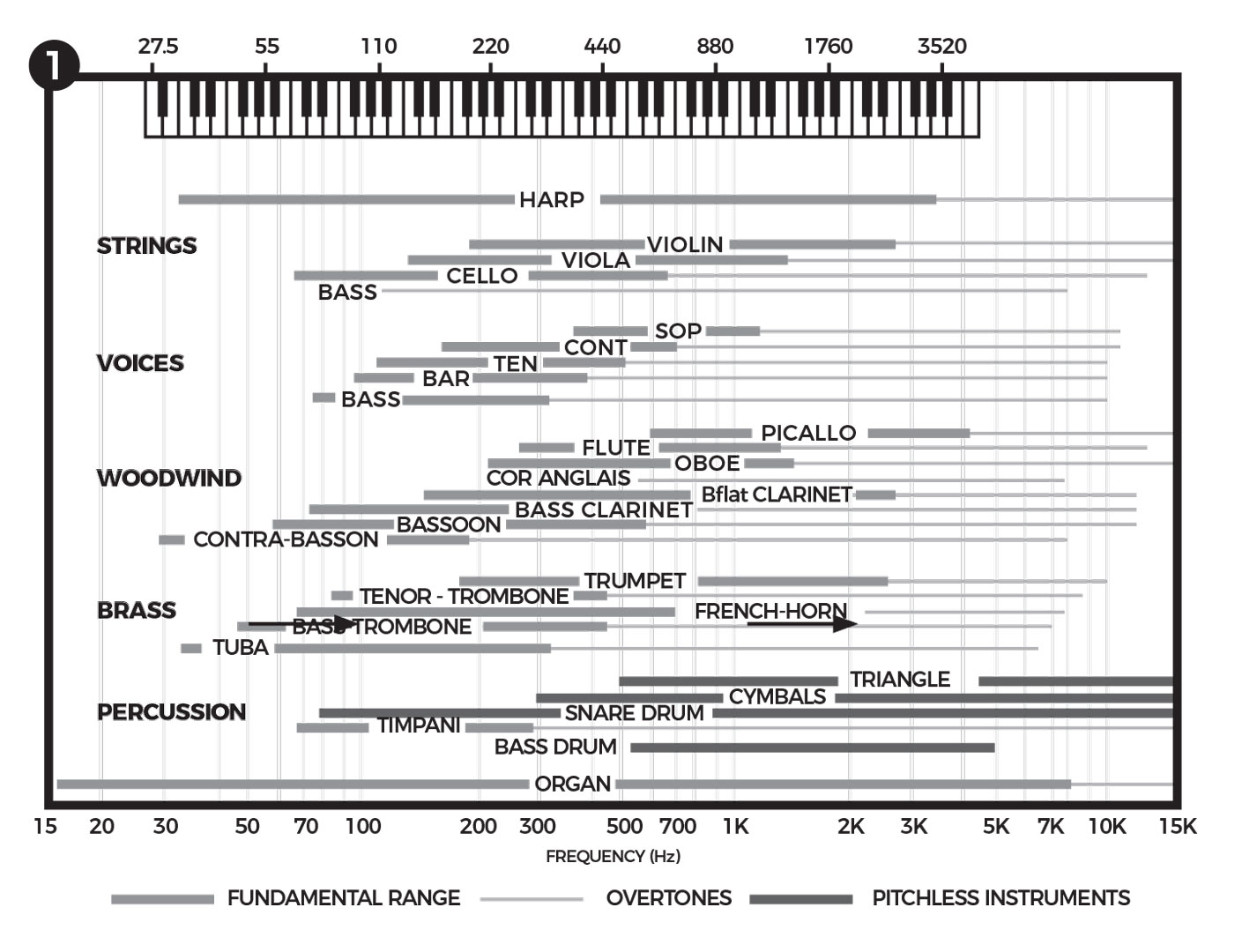
Looking at the frequency range of musical instruments and human hearing, the accepted range is taken as extending from 15 to 20kHz including the harmonics of instruments. It is these harmonics that give instruments their character (Fig. 1). However more recent research has shown there is considerable energy above 20kHz, with most instruments showing energy above 40kHz. Even sibilants in speech were found to have energy above 40kHz. It is the pitchless instruments, such as members of the percussion family that generate the greatest amount of ultrasound. A cymbal crash has been measured as having 40% of its energy above 20kHz, while a triangle was found to have a healthy output at 100kHz. Research has shown we are able to perceive this energy, concluding the mechanism was through bone conduction, probably to a small organ in the inner ear called the saccule, that responds to acceleration and gravity, which is effectively linked to the cochlea, the organ responsible for hearing as we know it.
Harmonics, Phase & The IsoFlareTM Point Source
Fyne Audio’s IsoFlare driver is a point source system whereby the bass / midrange driver shares a common time aligned centre with the high frequency unit. Providing outstanding stereo imaging, even off axis, energy is radiated isotropically with constant directivity, following the flare of the driver cone. Sound is produced as if emanating from a single point in space.
Over the frequency range that the IsoFlare operates, it does a far better job of preserving the harmonic content of instruments compared with a conventional discrete drive unit arrangement. This is because the low and high frequency sounds are generated from the same point in space (point source), and there are no time and phase differences between harmonics below and above the crossover point, as with discrete speakers.
Also, the relationship in amplitude of fundamental and harmonics is accurately preserved both on axis and at points off axis. In a normal room, the majority of sounds perceived by the human ear are reflections generated by the off axis response of the speaker. The even off axis response of the IsoFlare means that the reflected energy has the same harmonic structure as the direct on axis energy.
Another consequence of the IsoFlare’s point source nature is its linear phase response. Every loudspeaker or audio device exhibits a low pass filter function and consequently acts as a frequency independent time delay in the pass band, otherwise known as a linear phase response.
This better preserves the harmonic relationship of instruments and improves the transient performance. Note though that the phase response does deviate from the ideal at very high and very low frequencies. This is a natural result of the high and low frequency roll off points of the system. To reduce the low frequency phase error, we would add a subwoofer, which does more than just add bass. It is this reduction of phase error that is one of the main benefits of a well integrated subwoofer. Music with no apparent bass content will sound more natural when this error is removed.
Likewise, the addition of a super tweeter, time aligned to the acoustic centre of the IsoFlare, will reduce the high frequency phase error by moving the low pass roll off point much higher. So even if we ignore for now the perception of sound above 20kHz, the addition of a super tweeter will better preserve the harmonic relationship between instruments and is apparent down to low frequencies. This is a very important fact which is not intuitive, and it means a super tweeter will affect the overall sound across the frequency domain, not just at high frequencies.
So, for a super tweeter to work correctly in the time domain, it has to be positioned backwards on the cabinet, to match the acoustic source of the main driver.
We can now appreciate how adding a super tweeter improves system performance, not just with wide band material such as hi-res digital files, vinyl and tape, but with limited bandwidth material such as 22kHz CD Red Book standard.
Why Omnidirectional Super Tweeter?
As we stated initially, the concept of a super tweeter is by no means new and over recent years, commercial examples have come to market by other manufacturers. These are designed to sit on top of the main loudspeaker cabinet and radiate energy directly at the listener, either from a directly radiating dome, a ribbon transducer or similar device. Such devices will have a very narrow dispersion at these ultrasonic frequencies, which means they will beam like a torch.
We noted earlier that the relationship in amplitude of fundamental frequency and harmonics needs to be accurately preserved both on axis and at points off axis. In a typical room, a high proportion of sounds perceived by the human ear are reflections generated by the off axis response of the speaker. The even off axis response of a point source IsoFlare driver means that the reflected energy has the same harmonic structure as the direct on axis energy. Therefore, any enhancements by means of a super tweeter are best served by an omnidirectional device with even response at any angle, placed at the acoustic centre of the main driver, rather than a forward facing one, that beams energy directly at the listener.
Thin Ply Carbon Diaphragm
To give an extended high frequency response, it is typical to use a metal dome radiator. All these materials can suffer from a break-up mode, where the dome stops acting as a piston, and becomes uncontrolled resulting in a peak in the response of some 10dB or more, from around 20kHz to 30kHz. Although generally considered outside the audio band, this can still be perceived as harshness as well as limiting the maximum frequency the tweeter can operate.
The solution we have adopted is to use a new and unique Thin Ply Carbon Diaphragm (TPCD), the result of the material science and technology used to engineer TeXtreme® thin ply carbon fabrics. Where a conventional carbon fabric is woven from thick round yarns, a TeXtreme carbon fabric is woven from ultra-thin carbon tapes.
This results in higher stiffness, lower weight and tailored properties. By optimising the thickness and stiffness in all areas, the Composite Sound Metamodal diaphragm can be engineered for a tailored modal behaviour, frequency response linearity, improved pistonic motion and moving mass optimization, as required. The modal behaviour can be tailored by optimising thickness and stiffness in different parts of the cone or diaphragm.
The concept of distributed break up ensures a controlled break up behaviour with low distortion. By varying the properties of the TPCD in different areas and directions, the symmetric break-up modes are eliminated and replaced with smaller and local distributed break up modes, enabling a more linear and extended frequency response, without any high level resonances. This makes use of COMSOL composite and acoustic simulations to optimize thickness, stiffness and damping at every given point of the diaphragm to achieve this. Thus, the frequency response of our super tweeter extends to over 60kHz.
Thus, by using this newly developed patented time aligned omnidirectional super tweeter, the reflected energy in the room has the same harmonic structure as the direct on axis energy, thus giving advantages in perceived air and space compared to a more conventional forward firing super tweeter.
The IsoFlare driver, with its superior time alignment in the first place, benefits particularly from the addition of the super tweeter, while still acting effectively as a coincident point source, as it is still responsible for generating the vast majority of musical information.
The SuperTrax acoustic diffuser makes use of a Tractrix profile. The Tractrix profile is known to maintain a 90 degree angle at each intersection of the expanding wavefront. The plane acoustic wavefront generated by the dome is translated into a spherical wavefront into the room, where it meets the diffuser. Fyne Audio made use of the Tractrix profile in their patented BassTrax™ loading system, where the principles are similar.
Crossover
Although simple in topology, the designs are computer optimised and fine tuned subjectively by critical auditioning.
The crossover makes use of high quality precision components, including low loss LF laminated iron core inductors and Caddock high thermal stability non-inductive thick film resistors. ClarityCap® high grade PURTM HF polypropylene capacitors ensure very low levels of microphony and an extremely low noise floor. High quality gold plated WBT Nextgen™ bi-wire terminals are used, together with Neotech™ PC-OCC internal wiring with virtually no crystal imperfections for transparent signal transfer. The crossover is hard wired on fibre board panels to minimise vibration.
A special in-house designed autotransformer using the highest grade silicon steel laminations impedance matches the HF compression driver to the amplifier, with varnish vacuum impregnation to eliminate distortion caused by winding vibration.
Cryogenic treatment of the complete crossover relaxes stresses in materials and solder joints to maximise signal transparency. A grounding terminal is fitted to minimise the effect of radio frequency interference masking fine detail.
BassTraxTM Tractrix Diffuser System
The F1-10 Anniversary employs a downwards firing port arrangement using an advanced twin-cavity reflex loading system. This internal architecture divides the cabinet into two distinct chambers. The drivers are loaded into the upper chamber, which vents into the lower cavity via an internal port.
This complex internal chamber design offers several acoustic benefits:
• Smoother Bass Response: By tuning the two cavities to different frequencies, the system broadens the bass reflex tuning range, resulting in tighter, more controlled, and deeper low-frequency output.
• Reduced Standing Waves: Separating the enclosure into two cavities acts as a mechanical “muffler,” blocking unwanted standing waves and turbulence produced by the internal port.
• Moderated Cone Excursion: The tuned cavities act as an acoustic buffer, moderating the movement of the bass cone and allowing for increased power handling.
The BassTrax diffuser gives 360-degree Dispersion: The lower cavity ports downward onto Fyne Audio’s Tractrix diffuser, used to convert the plain wave energy to an expanding spherical 360-degree wavefront, dispersing energy uniformly into the room. This Tractrix profile has been previously applied to horn loudspeakers by Voigt in the 1920’s, but the application to a diffuser of this type is novel and has been granted a patent.
The Tractrix profile is known to maintain a 90 degree angle at each intersection of the expanding wavefront, thus avoiding reflections. This clever arrangement also makes the loudspeaker less critical of room positioning.
Enclosure
The high density birch ply construction is pressed to ensure an extremely rigid and low colouration structure. The drive unit is coupled to internal bracing panels through damping material to absorb energy. This high-grade Baltic birch has a high strength-to-weight ratio, durability, and excellent acoustic properties. Unlike solid wood, its layered construction prevents warping, while its rigidity helps prevent cabinet vibrations that distort sound.
This results in high stiffness and good resonance control: The cross-grained layering of veneers results in an incredibly stiff structure. This high stiffness pushes the cabinet’s natural resonance frequencies higher, moving them well above the operating range of the low frequency driver so as not muddy the bass.
The cabinet is finished in a highly decorative premium American walnut and Burr walnut veneer. The top panel is constructed using both American walnut veneer and American walnut solid rails to achieve the intricate edge profile. The assembly process is incredibly precise. The piano gloss finish uses a UV-resistant polyurethane lacquer that provides highly durable protection.
A high mass machined aluminium platform provides exceptional stability for precise low frequency performance and resolution of fine detail and also is an integral part of the BassTrax diffuser system.
Heavy duty support spikes, adjustable from above enable precise levelling, with the provision of machined aluminium cups for protection on wooden floors.
• Before installing these loudspeakers please read this manual in full,
both for safety reasons and to ensure you achieve the best performance
possible.
• When unpacking, please follow the instructions carefully, to avoid causing
possible injury or damage. Please ensure you have the help of an assistant.
• Please retain packing for possible future use.
• Check contents of the accessories box
Your accessories box includes
• Floor coupling spike M16 (x8)
• Spike locking wheel (x8)
• Floor protection cups (x8)
• Felt pads for protection cups (x8)
• Spike adjustment tool (x1)
• Bi-wire links (x4)
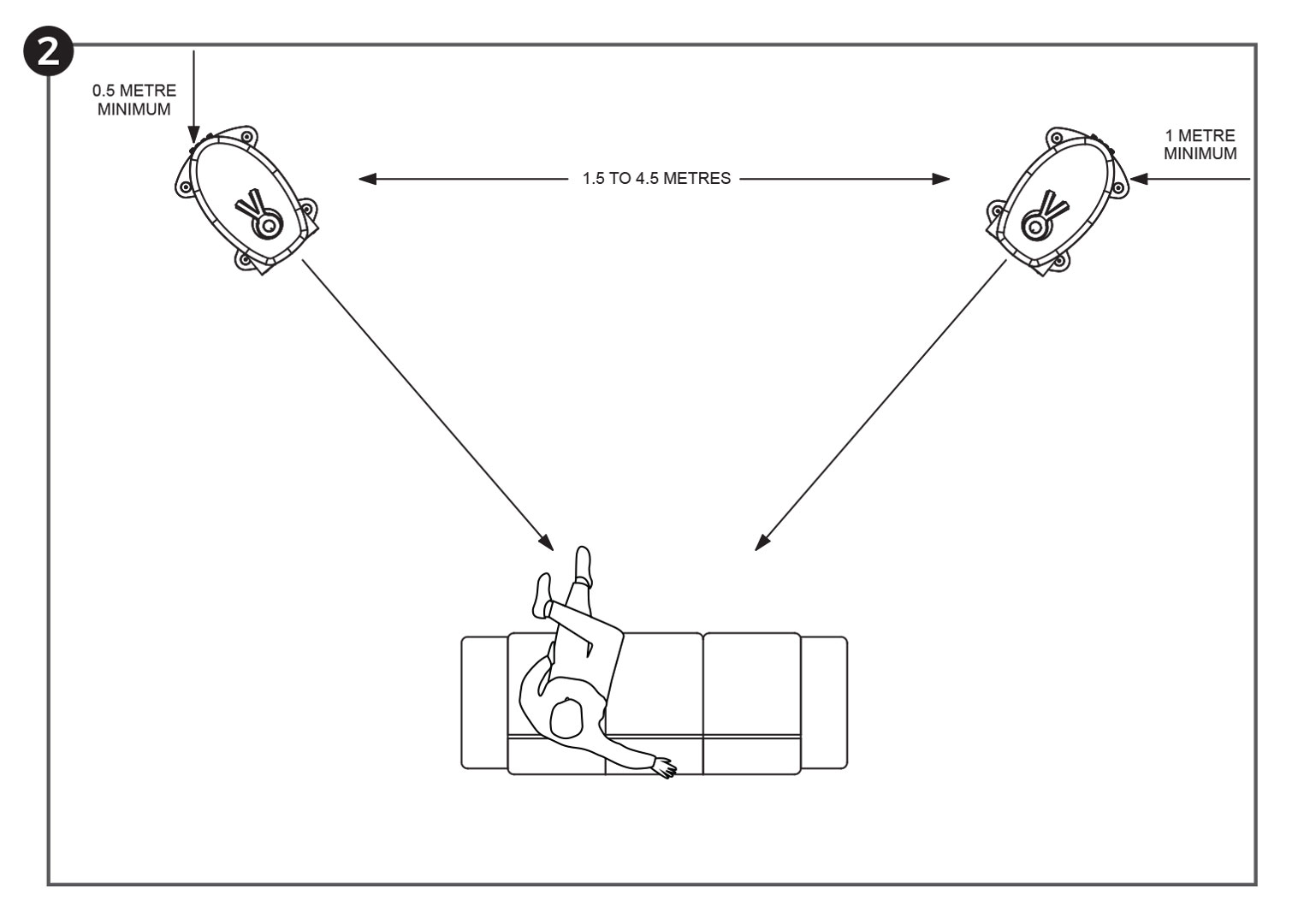
This operation should be performed by two people to avoid injury or damage to the loudspeaker, should it slip or fall. With the loudspeaker still located on the foam end cushions, start by positioning the loudspeakers with their rear at least 0.5m from the rear wall.
The proximity of a side wall should be no closer than 1m (Fig. 2). Remember that proximity to the rear and side walls will influence both the bass performance and stereo imaging. Excessively reflective or dissimilar adjacent walls will be detrimental to the stereo image precision. The imaging focus is influenced by toeing in the cabinets towards the listening position. The BassTrax™ diffuser system however, will serve to make the loudspeaker less sensitive to boundary conditions than with a conventional design.
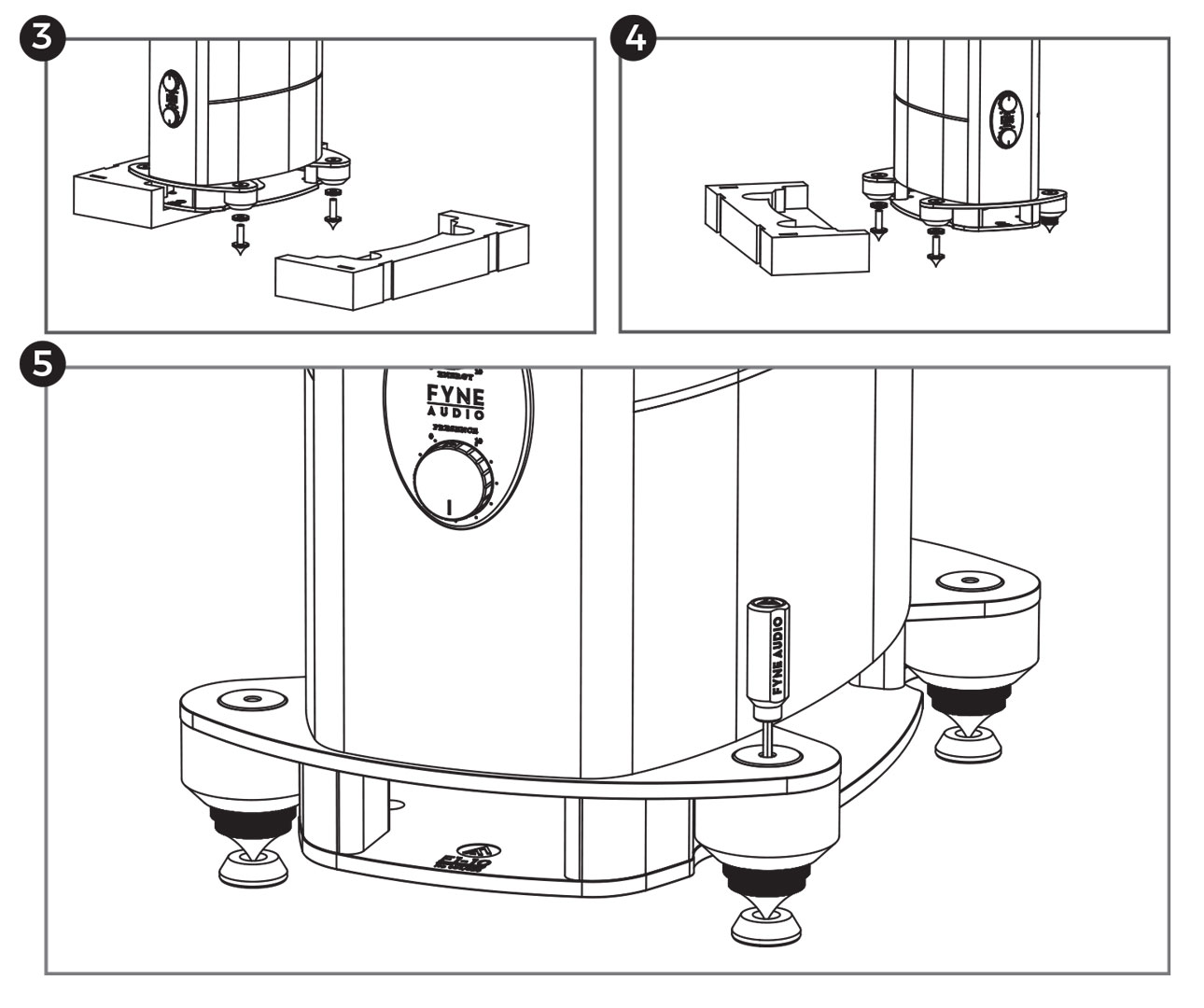
Referring toFigs. 3 – 5 and with the help of an assistant, remove the foam end cushion from one side of the loudspeaker, and fit two of the floor coupling spikes and locking wheels. Repeat for the other side of the loudspeaker.
Using the adjustment tool provided, level the loudspeaker from above and tighten the locking wheels.
Ensure the protective cups are used under the spikes to avoid damage to wooden or other delicate floor surfaces, using the felt pads if necessary.
The advisable range of amplifier powers is detailed in the Specification. Responsible use with higher powered amplifiers is possible, due to the robust design of these loudspeakers.
We do not advocate any specific amplifier technology, i.e. transistor versus valve (tube). As with any high resolution loudspeaker system, it is the quality of the amplification that is paramount in extracting maximum performance from your loudspeakers. Some customers may wish to use valve (tube) amplifiers such as single-ended triodes, with output powers less than the minimum recommendation. This will not cause damage to the loudspeakers, but will restrict the maximum volume and dynamic range, especially in large rooms.
If you are considering the purchase of a new amplifier, your dealer will be able to give you recommendations that work well.
It is important to use cables of appropriate quality for such a high performance loudspeaker. While from a technical perspective, low electrical resistance is necessary to minimise losses and maximise amplifier damping, the physical construction of the cable including conductor type and purity, together with insulation characteristics have considerable influence on the sound quality. The optimum cable is both subjective and system dependent; your dealer will be able to give advice.
Cables should be terminated in high quality connectors, either 4mm banana or spade. We would recommend the use of WBT Nextgen™ connectors.
Ensure the amplifier is switched off before connecting cables, to avoid damage.
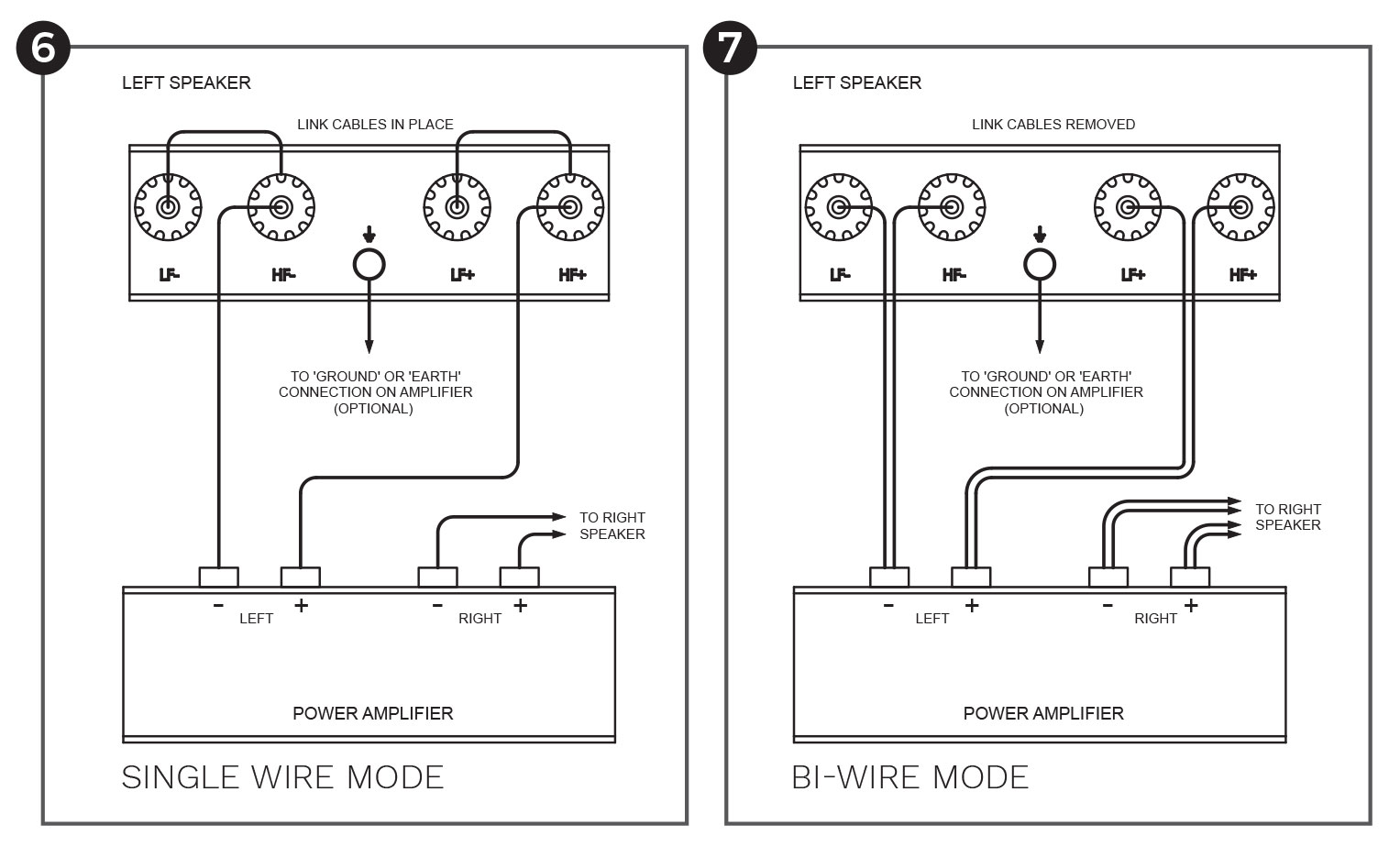
The loudspeakers are provided with two sets of terminals, one for the HF and one for the LF section. Wiring may be done in either single wire mode or bi-wire mode. The latter will provide optimum performance.
When using a single cable, wire as shown fitting the link cables provided (Fig. 6). The best sound quality will be achieved when connecting to the HF terminals. For bi-wire operation, ensure the link wires are not fitted, and wire with two sets of cable, or a dedicated bi-wire cable (Fig. 7). This will ensure the best possible sound quality.
A further option is bi-amping, where the LF and HF sections of the loudspeaker are each driven from their own amplifier, for further enhancement in sound quality (Fig.8). Either two stereo power amplifiers or four monoblock amplifiers may be used. If using two stereo amplifiers, it is recommended that one is used as the LF channel to both loudspeakers and the other HF. To avoid amplifier damage, the link cables must not be in place.
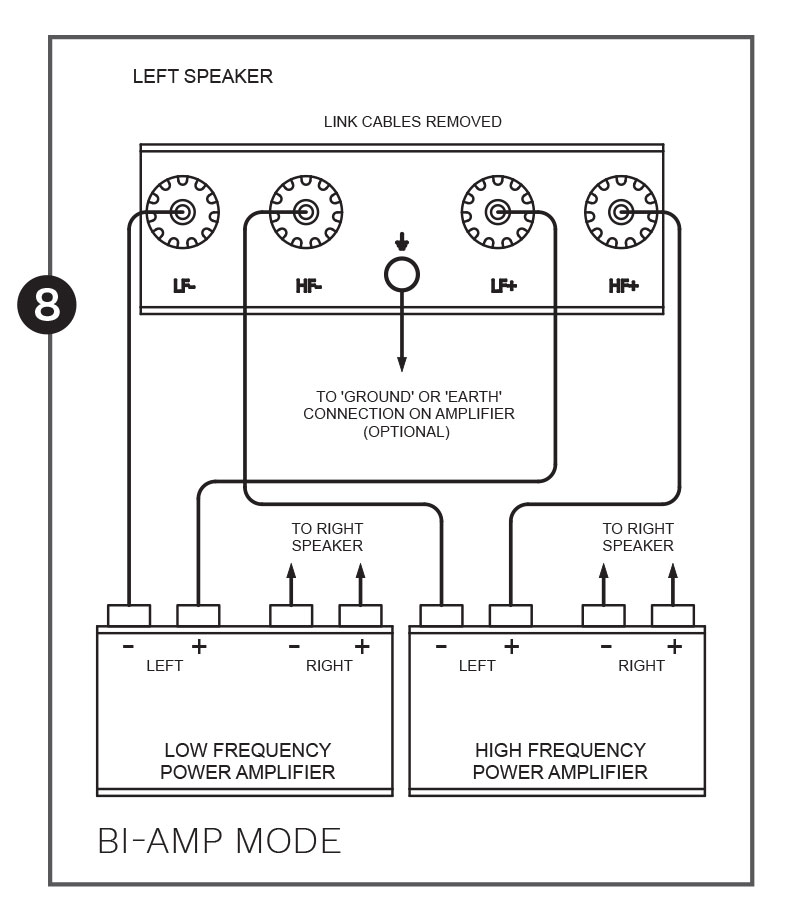
The loudspeaker is provided with an earth or ground connection, connected to the drive unit chassis. The purpose of this is to ground any radio frequency interference that may get back to the amplifier, reducing fine detail and resolution. A separate earth wire may be used for this purpose, run to the amplifier ground. Best results will be obtained by using a dedicated screened loudspeaker cable.
The F1-10 Anniversary is provided with two adjustment controls on the front panel and one on the top, to achieve optimal performance in terms of both the listening environment and listener preference.
On the front panel, the upper Energy control alters the level of signal fed to the tweeter, from the crossover point upwards, giving control over how bright the presentation sounds (Fig. 9). The crossover point is 750Hz.
The lower Presence control only affects the lower treble region of 2.5 – 5.0kHz, and influences articulation, vocal clarity and image depth (Fig.10).
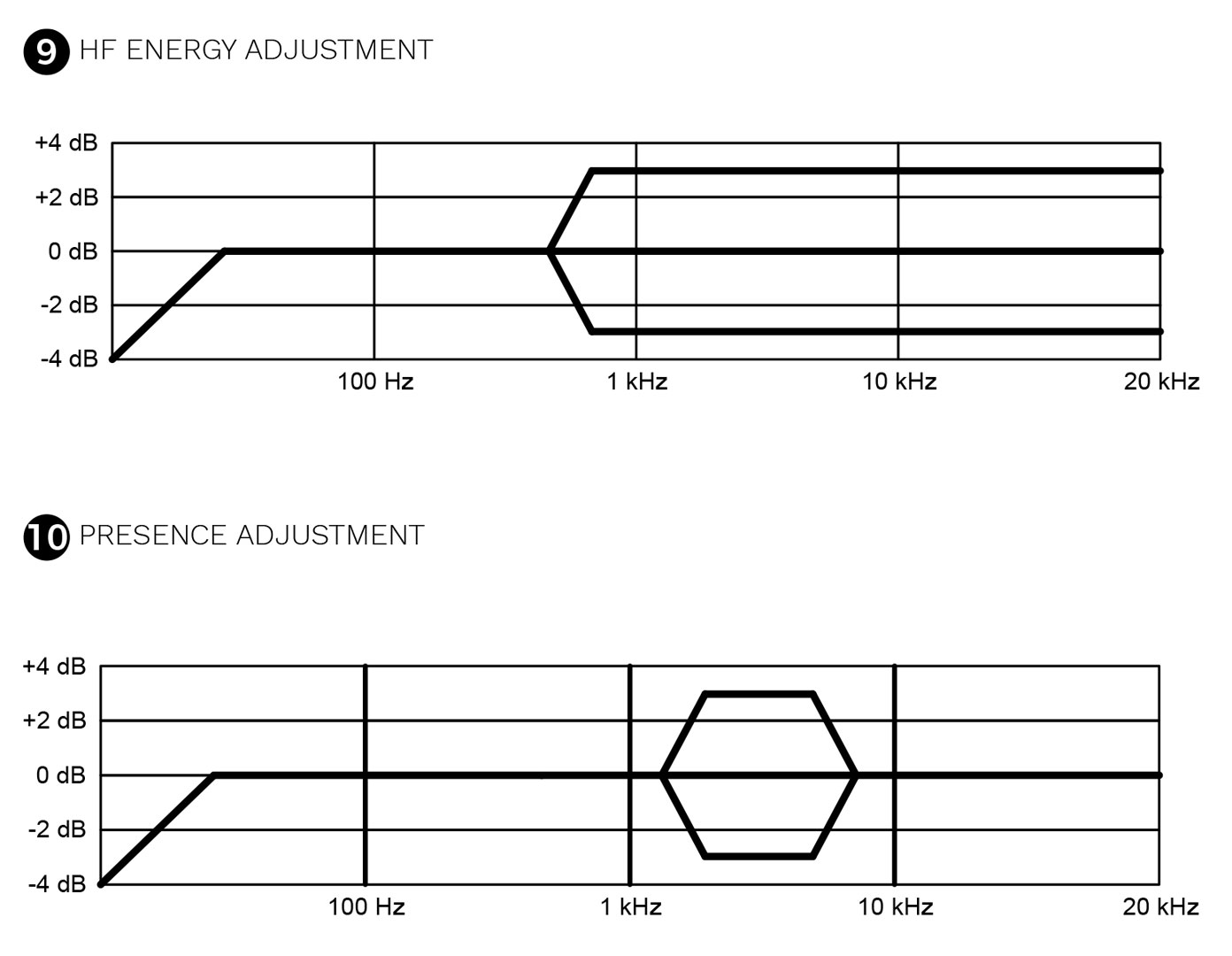
Start with both controls in the central (level) position, and make small adjustments with well recorded programme material that you are familiar with. Achieving the correct presentation is equivalent to focusing the lens on a camera, to achieve the most realistic sound-staging depth. The super tweeter is provided with a top mounted Level Adjustment, which enables a +/- 3dB range. The main audible effect is to increase the sense of air and space within the sound field, to give a more realistic experience. Just like a subwoofer, the super tweeter should not draw attention to itself, but rather offer a natural enhancement. Using well recorded programme material that you are familiar with, start with the level control in the centre position and experiment from there. You may well find yourself setting the level too high initially, so take your time in finding the right setting.
The cabinet and metal work may be cleaned with a microfiber cloth. Occasionally use a high quality non-silicone furniture polish on the high gloss wooden areas. As wood is a natural material, avoid exposure to extremes of heat, humidity and direct sunlight for extended periods of time.
If unused for long periods of time, you may wish to cover the loudspeakers with the cloth bags they were packaged in, to provide protection.
On no account use solvents or abrasive materials, as this will cause damage and invalidate the warranty.
Like all loudspeakers, being electro-mechanical devices, the F1-10 Anniversary requires a degree of running in to reach optimum performance. We recommend simply listening to them at normal levels for around 200 hours to achieve this, although further improvements will be apparent over a longer period of time.
All Fyne Audio products purchased from an authorised distributor or retailer are covered by a manufacturer’s warranty, subject to presentation of a valid proof of purchase. This warranty is provided in addition to, and does not affect, your statutory rights as a consumer under applicable national or local laws.
Full warranty terms and conditions are available at www.fyneaudio.com/warranty. Alternatively, you may request a copy or obtain further assistance by contacting our Customer Service Department by telephone on +44 (0)141 428 4008 (charges may apply for calls made from outside the UK), by email at enquiries@fyneaudio.com, or by post at:
Fyne Audio Limited
No. 1 Cubitt Court
Belgrave Street
Bellshill
North Lanarkshire
ML4 3NP
United Kingdom
| System Type | 3 way, downwards firing port, with patented BassTrax Tractrix diffuser |
|---|---|
| Recommended amplifier power (Watt RMS) | 20 - 280 |
| Peak power handling (Watt) | 560 |
| Continuous power handling (Watt RMS) | 140 |
| Sensitivity (2.83 Volt @ 1m) | 94dB |
| Nominal impedance | 8 Ohm |
| Frequency response (-6dB typical in room) | 26Hz- 60kHz |
| Drive unit complement | 1 x 250mm IsoFlare point source driver, multi-fibre bass / midrange cone, with 75mm dome Aluminosilicate ultra-thin diaphragm compression tweeter, neodymium magnet system 25mm (1”), Thin Ply Carbon Diaphragm (TPCD) super tweeter with neodymium magnet system |
| Crossover frequency | 750Hz, 16kHz |
| Crossover type | Bi-wired passive low loss, 2nd order low pass, 2nd order high pass (IsoFlare), 3rd order high pass (super tweeter), Deep Cryogenically Treated |
| System adjustments | High frequency energy (> 750Hz) +/- 3dB Presence (2.5kHz - 5.0kHz) +/- 3dB Super tweeter energy (16kHz – 60kHz) +/- 3dB |
| Dimensions - HxWxD | 1247 x 405 x 585mm (49.1 x 15.9 x 23.0”) |
| Cabinet Construction | Birch ply with solid wood trim and extensive internal bracing |
| Net Weight - Each | 58.7kg (129.4lbs) |